Add Floating Share Buttons To Your Blog

Hi Everyone those who looking for a great widget for social sharing of web site's & blog there is a good news. Now you can easily add floating share buttons like one in the floating in the left, very easily in 4 steps.

With This widget any visitor visiting your blog post can share the port on social networking sites like facebook, twitter, digg, stumbleupon etc

The user sharing your site on social networking sites or like it on FBwill drive more traffic to your website ,blog; this is because as your popularity grows share,like on social networks it will drive more traffic to your blog, so you should do all you can; to link your blog website to these social networking websites.

One good way of doing this is to add some nice share buttons to your blog. Share buttons allow your readers to easily share the contents of your blog or website with their friends on various social networking websites where they are members.

So we shall be adding some nice floating share buttons to your blog. what this floating share button does is to follow your visitors to any place they navigate to on your blog. To understand better, focus your eyes on
the right hand side of this page and scroll with your mouse. You will notice that some buttons are following you around saying "hey click me"   funny and nice right? ok let's add same to your blog.

I shall be using a blogger blog to illustrate but same procedures applies to wordpress blogs too.


  • Log in to your blogger account.
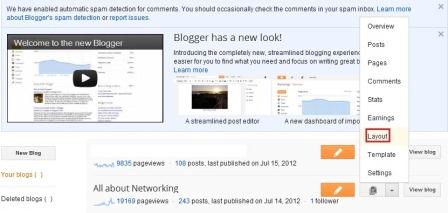
  • Click Layout under the name of the blog you are adding the floating share buttons.


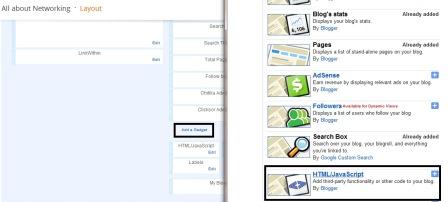
  • In the next page click Add Gadget, When the list of basic gadgets come up, select the HTML/JavaScript gadget.
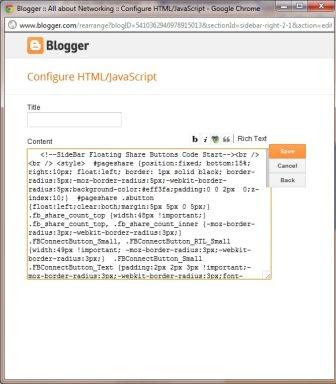
  • Now, copy the codes below and paste them into the body section of that gadget (leave the title field blank)
Copy Paste below code into your widjet.

    When you paste the codes, click Save and view your blog. you should see some
    share buttons following you everywhere you go.
    If you like this post, please use the comment form below to say THANKS.
    Enjoy!

    Comments

    Mathieu Deflem said…
    This one worked for me! Thanks. I wish to change the design though, but I will find that out. Thanks again.
    John Richards said…
    Thanks for Sharing this awesome script for floating widget.
    Regards,
    BeingSalmanKhan

    Popular posts from this blog

    INSTALL CISCO VPN CLIENT ON WINDOWS 10 (32 & 64 BIT). FIX REASON 442

    This article shows how correctly install Cisco VPN Client (32 & 64 bit) on Windows 10 (32 & 64 bit) using simple steps, overcome the ‘ This app can’t run on this PC ’ installation error , plus fix the Reason 442: Failed to enable Virtual Adapter error message . The article applies to New Windows 10 installations or Upgrades from earlier Windows versions and all versions before or after Windows 10 build 1511 .  To simplify the article, we’ve broken it into the following two sections: How to Install Cisco VPN client on Windows 10 (clean installation or upgrade from previous Windows), including Windows 10 build prior or after build 1511 . How to Fix Reason 442: Failed to enable Virtual Adapter on Windows 10 Figure 1. The Cisco VPN Client Reason 442: Failed to enable Virtual Adapter error on Windows 10 HOW TO INSTALL CISCO VPN CLIENT ON WINDOWS 10 (NEW INSTALLATIONS OR O/S UPGRADES) The instructions below are for new or clean Windows 10 inst...

    Linux File and Directory Permissions

    file & directory protection is a essential of any OS and Linux OS is no exception for it! These authorizations allow you to choose exactly who can access your files & directory, providing an overall improved system security. There was one of the major flaws in the older Windows operating-system where, by standard, all users can see each other people's information (Windows 95, 98, Me). For overcoming it, editions of the Windows based computer system such as NT, 2000, XP and 2003 lot more security features added. They fully support file & directory permissions, just as Linux system has since the beginning. Together, we'll now assess a directory listing from our Lab Linux system hosting server, to help us understand the information provided. a simple 'ls' command will give you the file and directory listing within a given directory, including the option  '-l' will display number of new areas that we are going to discuss here:

    How to create a Hirens Boot CD 15.2 USB Disk

    Hiren’s BootCD (HBCD) is a bootable CD that contains a set of tools that can help users to fix their computer if their system fails to boot. More specifically, HBCD contains hardware diagnostic programs, partition tools, data recovery utilities, antivirus tools and many other tools to fix your computer problems.  I write this article because I use Hiren’s BootCD frequently to troubleshoot computer problems, specially when a computer doesn’t boot anymore due to a virus attack or due to a corrupted file system. In this article you will find instructions on how to put Hiren’s BootCD on a USB flash drive (stick) in order to troubleshoot computer problems in the future.