
Creating Kaspersky Bootable USB Rescue Disk

Kaspersky Rescue Disk 10 is designed to scan, disinfect and restore infected operating systems. It should be used when it is impossible to boot the operating system.
kasperskyRescue2USB is a windows utility software that allow you build bootable antivirus USB rescue disk to USB flash drive without kaspersky Antivirus / Kaspersky Internet Security 2011.


Create Kaspersky Rescue Disk On USB Flash Drive:

  • Connect a removable USB device to your computer. 
    Space capacity of it must be greater than or equal to 256 MB. The connected USB device must have FAT16 or FAT32 file system. If NTFS file system is installed on the device, you must format it in FAT16 or FAT32.
    Operating systems of machine used for making Kaspersky Rescue Disk 10 & infected computer must be the same.
  • Run the downloaded file rescue2usb.exe.
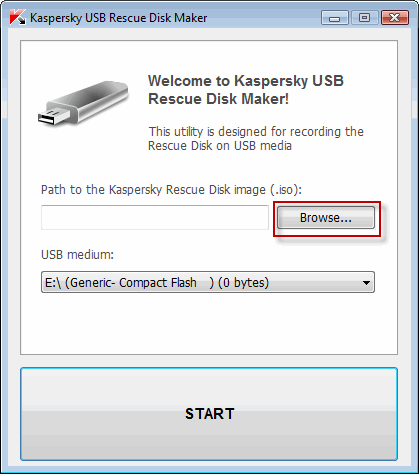
  • Once the Kaspersky USB Rescue Disk Maker window appear, click Browse... and select the iso image of Kaspersky Rescue Disk 10
  • Select the required USB device from the drop-down menu.
  • Click START & Wait until the process is complete.
  • Click OK on the open window informing that Kaspersky USB Rescue Disk has been successfully created.


How to Boot Kaspersky USB Rescue Disk:

  • Make BIOS settings to boot from USB drive.
  • Plug in Bootable kaspersky USB Rescue Disk into Computer USB port and boot the computer with USB Disk connected.
  • After reboot, a message will appear on the screen: Press any key to enter the menu. Press any key in 10 seconds, else the computer will boot from hard drive automatically.
  • Select one of the following start up methods:
    • Kaspersky Rescue Disk. Graphic Mode loads the graphic subsystem.
    • Kaspersky Rescue Disk. Text Mode loads the text user interface represented by the Midnight Commander (MC) console file manager.
    • Boot from Hard Disk.
  • Press the ENTER key on the keyboard.

Once Enter key is pressed , the operating system starts & It scans your computer for connected devices and searches for file systems of your local and removable disks. 


Comments

Popular posts from this blog

INSTALL CISCO VPN CLIENT ON WINDOWS 10 (32 & 64 BIT). FIX REASON 442

This article shows how correctly install Cisco VPN Client (32 & 64 bit) on Windows 10 (32 & 64 bit) using simple steps, overcome the ‘ This app can’t run on this PC ’ installation error , plus fix the Reason 442: Failed to enable Virtual Adapter error message . The article applies to New Windows 10 installations or Upgrades from earlier Windows versions and all versions before or after Windows 10 build 1511 .  To simplify the article, we’ve broken it into the following two sections: How to Install Cisco VPN client on Windows 10 (clean installation or upgrade from previous Windows), including Windows 10 build prior or after build 1511 . How to Fix Reason 442: Failed to enable Virtual Adapter on Windows 10 Figure 1. The Cisco VPN Client Reason 442: Failed to enable Virtual Adapter error on Windows 10 HOW TO INSTALL CISCO VPN CLIENT ON WINDOWS 10 (NEW INSTALLATIONS OR O/S UPGRADES) The instructions below are for new or clean Windows 10 inst...

Linux File and Directory Permissions

file & directory protection is a essential of any OS and Linux OS is no exception for it! These authorizations allow you to choose exactly who can access your files & directory, providing an overall improved system security. There was one of the major flaws in the older Windows operating-system where, by standard, all users can see each other people's information (Windows 95, 98, Me). For overcoming it, editions of the Windows based computer system such as NT, 2000, XP and 2003 lot more security features added. They fully support file & directory permissions, just as Linux system has since the beginning. Together, we'll now assess a directory listing from our Lab Linux system hosting server, to help us understand the information provided. a simple 'ls' command will give you the file and directory listing within a given directory, including the option  '-l' will display number of new areas that we are going to discuss here:

How to create a Hirens Boot CD 15.2 USB Disk

Hiren’s BootCD (HBCD) is a bootable CD that contains a set of tools that can help users to fix their computer if their system fails to boot. More specifically, HBCD contains hardware diagnostic programs, partition tools, data recovery utilities, antivirus tools and many other tools to fix your computer problems.  I write this article because I use Hiren’s BootCD frequently to troubleshoot computer problems, specially when a computer doesn’t boot anymore due to a virus attack or due to a corrupted file system. In this article you will find instructions on how to put Hiren’s BootCD on a USB flash drive (stick) in order to troubleshoot computer problems in the future.